Grottos Nebraska 2
This is a continuation from Page 1 of the list of Lourdes grottos in Nebraska:
St. Mary’s Church, Rushville (1930, not extant)
I could not find any images of the grotto built at St. Mary’s Church in Rushville, but found several good articles about it, especially this one:
If ever a priest took an interest in his Church and Parish we must hand it to Father Nepper. With the aid of some of his parishioners he has transformed St. Mary’s Church and High School into a veritable beauty spot in the town. His scholars raised $200 for flowers, shrubbery and landscaping, and Father Nepper has thrown off his coat and worked with vim, muscle and good taste in beautifying the grounds.
A striking feature forming a centerpiece of all this has been the erection of a duplicate of the Grotto which shrine was the talk Lourdes, of Europe ever since 1859. This is almost complete, the rockery work and the statue of the Virgin is in place, and a second statue of a child is on the way. At the base of the shrine is a pool of clear water, in which fish disport themselves. On the 15th of the month this will be formally dedicated on the Feast of the Assumption.
We love to see a man take a pride in his work in the community, for we only get what we work, and God is watching us. The Rushville Recorder, Aug 7, 1930
The grotto was dedicated on August 15, the Feast of the Assumption, 1930:
Last Friday on the Feast of the Assumption, a full church of parishoners was seen at St. Mary. The pastor preached a sermon during the high mass on the meaning and significance of the Assumption of Our Blessed Lady. All the married ladies and both Sodalities went to communion in a body. After the mass the pastor accompanied by the altar boys and followed by the entire congregation went to the grotto to bless the statues of Our Lady of Lourdes and of Bernadette. After the blessing of the two statutes hymn to the Queen of Heaven was sung.
The grotto was profusely decorated with vines, plants and flowers and presented an attractive appearance. The fountain filled with clean water with stone and pebble bottom contains a variety of fish. At night the entire grotto can be illuminated with intermittant flash light effect. The structure is composed of the white rock found near Rushville and was built to approach the famous grotto at the world renowned pilgrimage place of Lourdes, France. It is the center of the buildings and grounds of St. Mary and is a beauty spot in Rushville, attracting many of our townspeople and tourists. The statue of Bernadette was given by a Sodality girl and the rocks, sand, fish, vines and labor donated by members of the were parish notably by the boy’s sodality.
Various late flowers ard plants are to bloom so that when beginning school opens September 1, there will be masses of blooming plants and shrubs on the green plots that make St. Mary a much visited institution. The pastor feels grateful to all who gave a little of their time to put St. Mary on the list of Rushville attractions. If proud parishioners would now level the ground behind the dormitory for Father a new paradise could spring up there next spring. The Rushville Recorder, Aug 21, 1930
It’s not clear how long the grotto existed in Rushville. It was not mentioned by Rushville newspapers after 1931, and St. Mary’s church closed in the 1960s.
St. Mary’s High School, Omaha (1931, not extant)
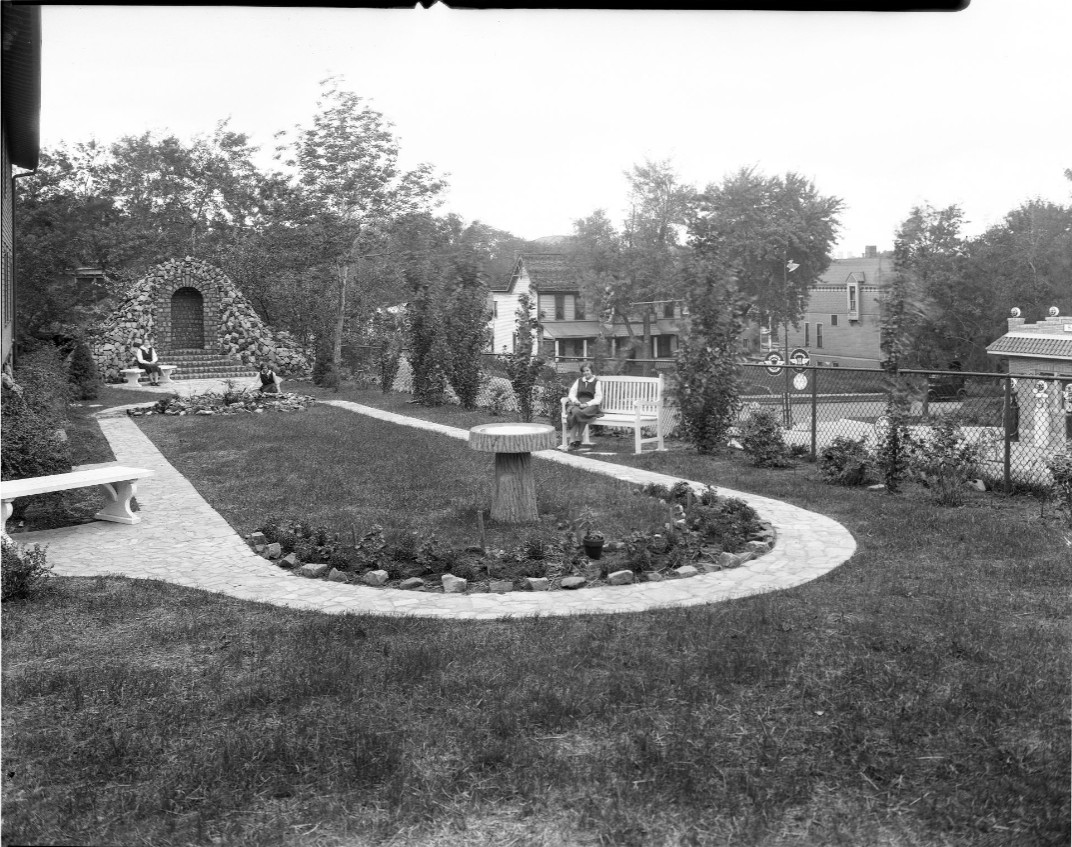
Several days before the grotto was blessed this tantalizing hint was published:
The exquisite beauty of our new statue which now stands veiled in the Grotto niche will be revealed to the student, body and all interested friends on the Feast of the Immaculate Conception. Our Sunday Visitor, Dec 4, 1931

And a photo of the veiled statue was pictured in a different newspaper, shown here.
The new grotto at St. Mary’s High School was blessed on December 8, 1931:
Omaha gained a new beauty spot Tuesday afternoon with the unveiling and blessing of a Carrara marble statue of the Blessed Virgin in the new grotto and garden at St. Mary High school, Twenty-seventh street and St.. Mary’s avenue.
Nearly five hundred attended the outdoor exercises and the pageant presented immediately following in the school auditorium. The presentation marked the first gift given the Sisters of Mary on the occasion of their one hundredth anniversary as a religious order. The Omaha group is 67 years old. Visible for Blocks. The outdoor ceremonies were held in a tent due to inclement weather. After a processional by 150 girls of the St. Mary High school and 40 young women from the College of St. Mary, Mgr. James W. Stenson, vicar general of the Omaha diocese, unveiled and blessed the statue.
With illumination it will be visible for blocks on St. Mary’s avenue. Omaha World-Herald, Dec 9, 1931
It’s not clear how long the grotto existed there; St. Mary’s High School merged with another school and moved. The grotto may have been located where the St. Peter’s Church parking lot has been built.
Mt. Carmel Home, Kearney (1934, not extant)
A May 1934 newspaper article stated that:
The Grotto of Our Lady of Lourdes, recently erected on the grounds of the Francis G. Keens’ Home for the Aged, Seventeenth street and Fifth avenue, will be solemnly dedicated on Sunday afternoon at four o’clock, by the Rev. H. Muenstermann. Kearney Hub, May 26, 1934
I could not find any photos of that grotto, and it does not appear to have survived–although the statues of Our Lady of Lourdes and Bernadette stand next to the front entrance in a nicely landscaped bed.
Spalding Academy, Spalding (1934, extant)
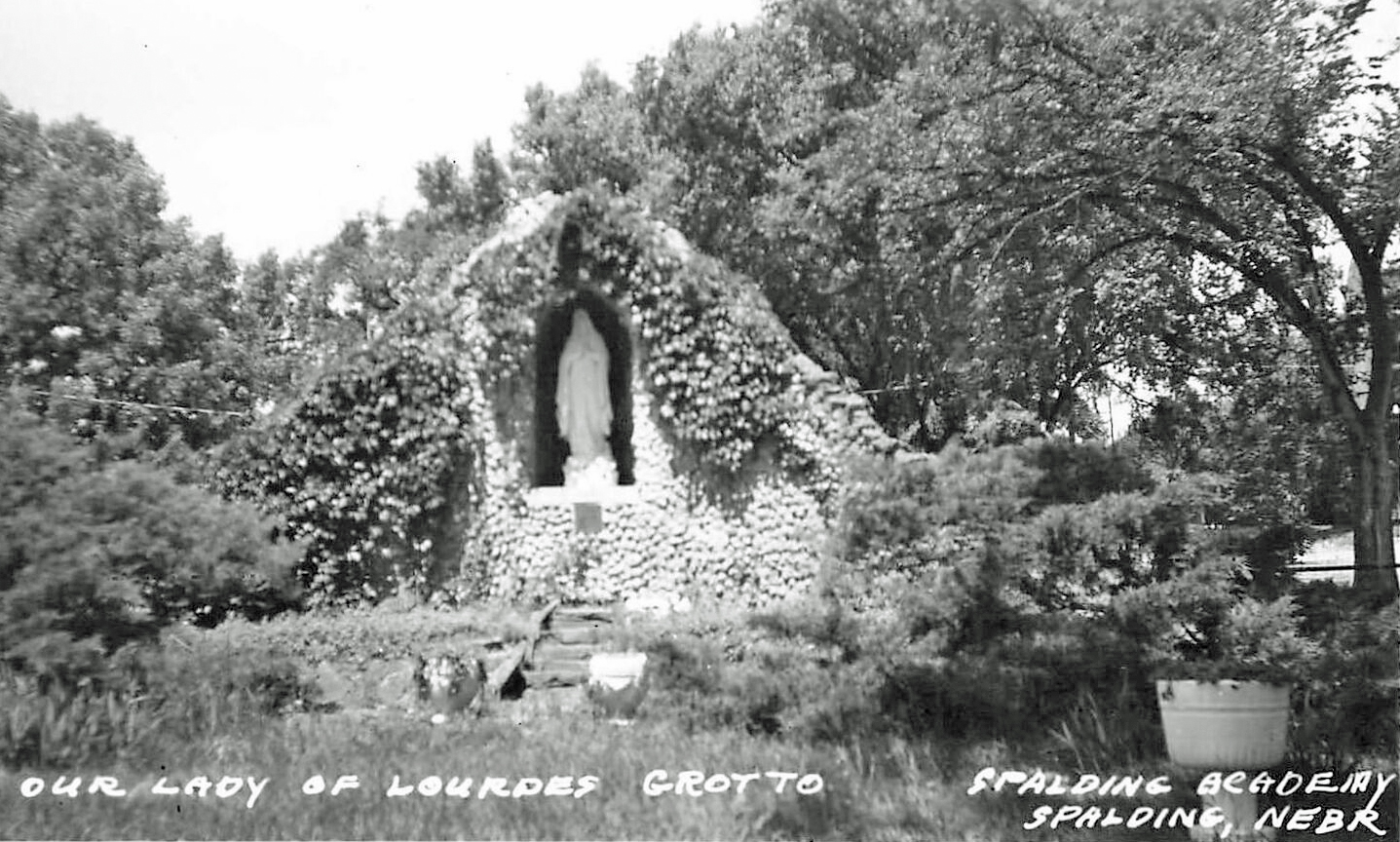
Spalding Academy was founded in 1891 in the town of Spalding, about 150 miles west of Omaha and with a population of around 400, and has continued to operate for more than 135 years. (Both the town and the academy were named after John Lancaster Spalding, first bishop of Peoria and a founder of Catholic University of America.)
In early 1934, a series of articles was published in the local newspaper:
Grotto To Be Built On Academy Grounds Local Clubs Give Proceeds of Benefit Party as First Donation. Spalding Academy at its erection was dedicated to Our Lady of Lourdes. For more than thirty years Our Blessed Mother has watched the progress of the institution under the careful guidance of the Dominican Sisters. This thirty-third anniversary of its erection seems a fitting time to honor its Patroness with a Grotto. The Spalding Enterprise, Feb 8, 1934
Work has been progressing on the grotto, being built on the grounds of the Spalding. Academy, just east of the school building. This grotto, when completed, will be the only one in this immediate part the state, It will be dedicated to Our Lady Lourdes, the patroness of the school. The Spalding Enterprise, Apr 12, 1934
Our Lady of Lourdes Grotto, now nearly completed, is attracting many admiring spectators. During the past week financial assistance has been gratefully received from the following; Our Lady of Lourdes Alumni, Mr. Michael Lacy, Miss Elizabeth Higgins, Mrs. Tully, Mrs. Daniel Flannigan, Mr. and Mrs. Fred Rasschaert. A brass plate, bearing the names of all who contribute twenty five dollars or more will occupy a prominent place on the Grotto. The names of donors will appear in this paper each week. Even the smallest offering will be appreciated. The Spalding Enterprise, Apr 19, 1934
The grotto fund is still increasing. We have collected up to date $214. The remaining $86 will, I am sure, be paid in the near future. We can then say the people of Spalding erected the grotto, and not the Sisters. A brass plate will be placed in front of Our Blessed Mother, bearing the names of those who donated $25.00. The names for that plate are as follows: (1) Spalding Benefactors (which will Include all donations less than $25); (2) Women’s local clubs; (3) Alumni; (5) Mr. R. Walsh, In memory of Sr. Henrica; (6) Miss Hannah Sullivan in memory of her father; (7) Miss Hannah Sullivan; (8) Mr. T. Naughtin, who gave his labor to the grotto. The Spalding Enterprise, May 31, 1934
The following made contributions to the Grotto fund the past week: Mrs. Michael Lacy, $10 Mrs. Fred Semper, $5 Mr. L. C. Harris, $5 Mr. Luke Finn, $5 Mrs. Mary Berger, $1. The Sisters wish to express their appreciation to Doctor Sullivan for supplying the gold fish, and to Walter Weber for the pond lilies for the pool on the Grotto grounds. The Spalding Enterprise, Jun 7, 1934
I could not find any published account of a dedication or blessing of the grotto, which seems to have been completed by May 1934. Landscaping work continued the following year:
The Academy Sisters wish to express their appreciation to Mrs. Luke Finn for donating a dozen hydrangeas to the Grotto grounds, Mrs. Finn commended the Sisters for their efforts to make Spalding beautiful and expressed delight in helping to add beauty to the shrine. The Grotto was built last year by the generous contributions of our friends as a token of loyal devotion to the Blessed Virgin. The grounds were beautiful in spite of drought. This spring the Sisters are renewing the work, and if any one has shrubs or plants to contribute to this beauty spot, we are, sure our Lady of Lourdes will be pleased and the Sisters will again be grateful. The Spalding Enterprise, Mar 21, 1935
The Sisters wish to thank Mr. Emil Kavalec for offering his personal service and special Interest in the work of beautifying the Grotto grounds. He is sponsoring a flower fund to which his wife has donated the first $5, and this column will publish each week the names of friends who contribute. Since Mr. Kavalec has had experience in landscaping gardens, we are most fortunate to have his kindly assistance. May Our Lady shower in the Spalding Community, all spiritual and temporal blessings, especially rain. The Spalding Enterprise, Apr 11, 1935
The Grotto grounds at the Academy present a truly beautiful aspect now. Plantings have been expertly arranged by Mr. Kavalec and the results are most gratifying. Spalding may be genuinely proud of this beauty spot. The Spalding Enterprise, Jun 27, 1935
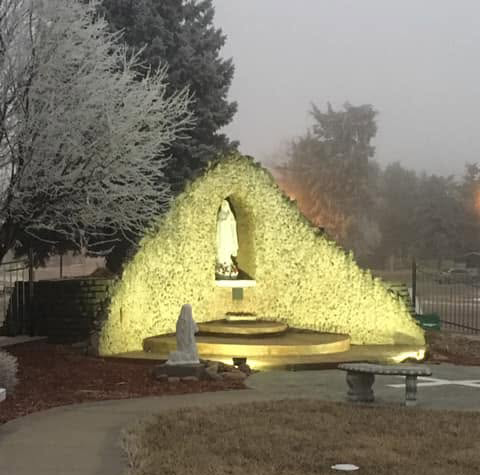
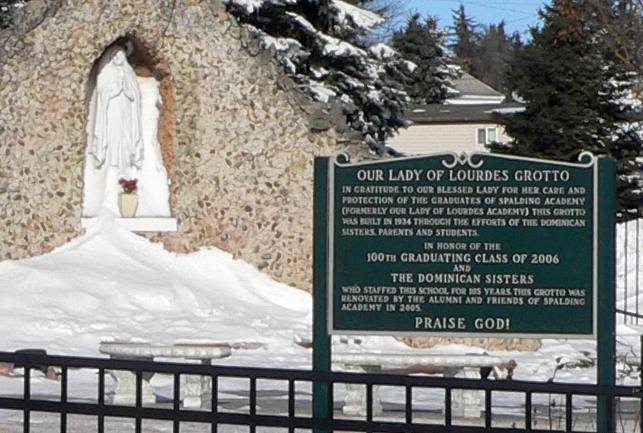
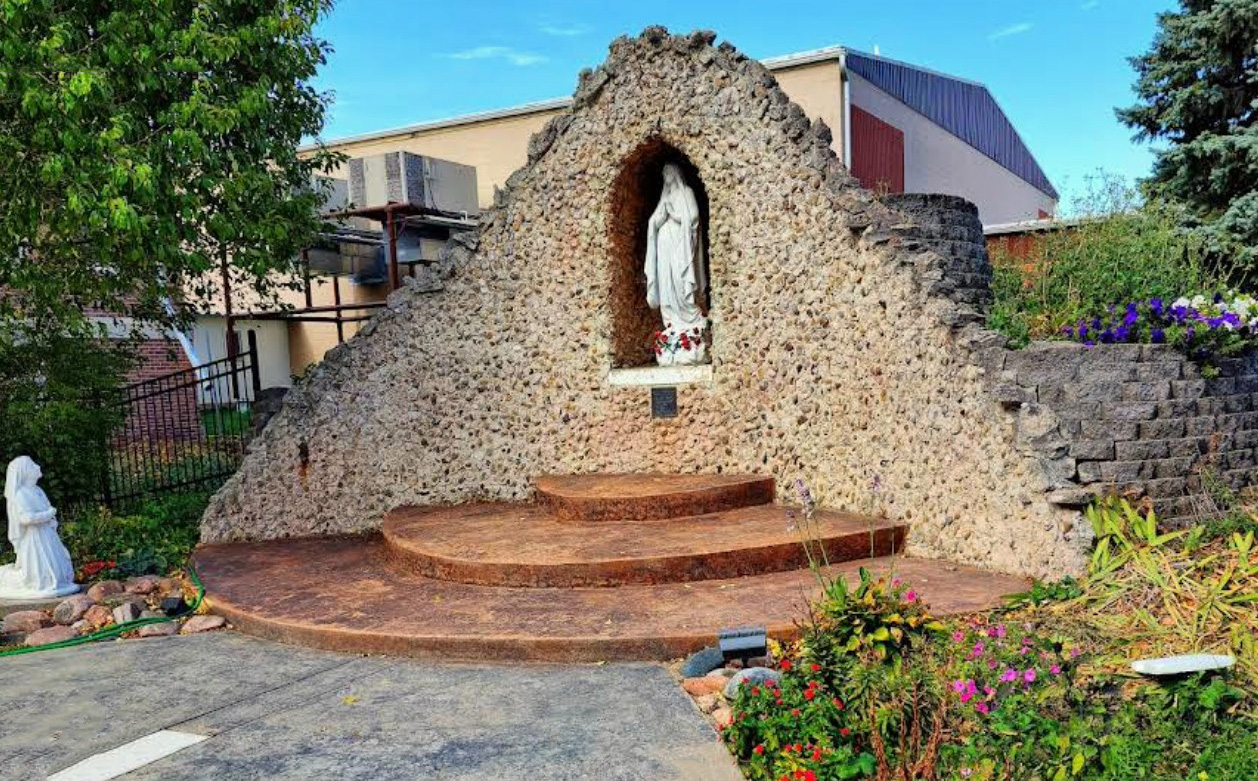
A sign in front of the grotto states that it was renovated in 2005, in honor of the 100th graduating class of 2006 and the Dominican Sisters.
Sisters of Mercy, St Clare’s Monastery, Omaha (by c.1935, not extant)
I could find very little information about the grotto at the Monastery of St. Clare in Omaha, except this c.1935 photo in the digital image collection of the Nebraska State Historical Society:
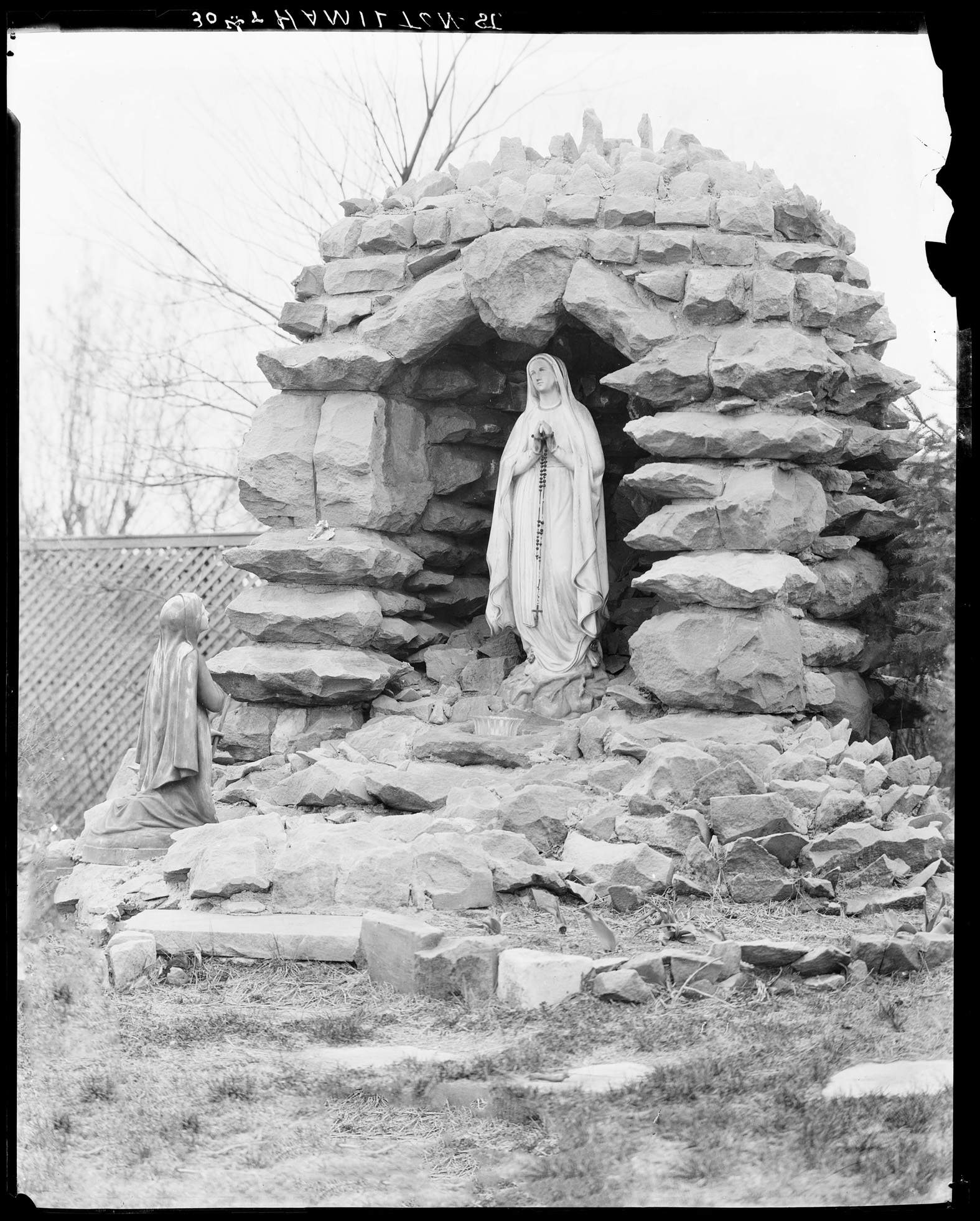
The Poor Clares resided at the monastery from around the turn of the century until 1971. The property is now a rental facility, the Starlight Chateau, and the grotto in the c.1935 photo does not seem to exist today (although a grotto built of stone blocks stands in the courtyard, and serves as a backdrop for weddings and photos).
Convent of the Good Shepherd, Omaha (1939, not extant)
I could not locate any photos of the grotto at the Convent of the Good Shepherd in Omaha (40th & Jones Streets), but two 1939 articles mentioned it: once in February when it was being completed, and again in early June:
Last Friday was a day that will live long in the memory of niembers of the Community of the Convent of the Good Shepherd in Omaha…. It was the occasion of the dedication of the new statue of Our Lady of Lourdes at the new Grotto on the north side of the Convent grounds.
The rock for the building of the Grotto was secured at Louisville last fall. It is set in a natural embankment, flanked with evergreen trees, bridal wreath and tamarisk, all on a natural slope. The true beauty of the Grotto consists in the fact that it looks as if Nature placed it there. It does not look artificial. The statue of Our Lady of Lourdes, the gift of Leo Maloney, brother of Sister Mary of Divine Shepherd, is one of the most beautiful we have ever seen. It stands six feet high.
Certainly the craftsman who carved the stone to form the statue must himself have loved Our Lady. It has a perfect natural finish. A waterline was piped to the base of the statue, which flows into a water lily pond a few feet in front of the Grotto. Taking everything into consideration, it is a beautiful rustic setting.. expense for the Grotto was donated by friends of the Institution, and was considered a labor of love by the donors. Our Blessed Lady will surely reward them….
It became a question how to arrange the crowd of over 400. Outside the grounds the sidewalk on Fortieth Street was lined with spectators. At 3 o’clock the girls’ procession of about 250, dressed in white, entered the grounds, led by a crossbearer and attendants. Next came the Children of Mary Sodality, all bearing palms about four feet long. Arriving at the Shrine, they formed an arch with the palms, through which the May Queen, crownbearer and attendants passed to the Shrine.
During the procession on the grounds all chanted the Litany of the Blessed Virgin. The Chaplain then blessed the new statue and dedicated the Grotto, but did not address those present, as everybody very restless. Then the hymn was sung and the crown placed on the head of the statue. Next the Act of Consecration was recited by the May Queen and the recessional Farewell, Dear, Mother, took place. Our Sunday Visitor, Jun 2, 1939
In 1971, the Sisters of the Good Shepherd moved to the building formerly occupied by the Poor Clares (see above section), and then left Omaha in 2009. It’s unknown how long the grotto existed at their first location.
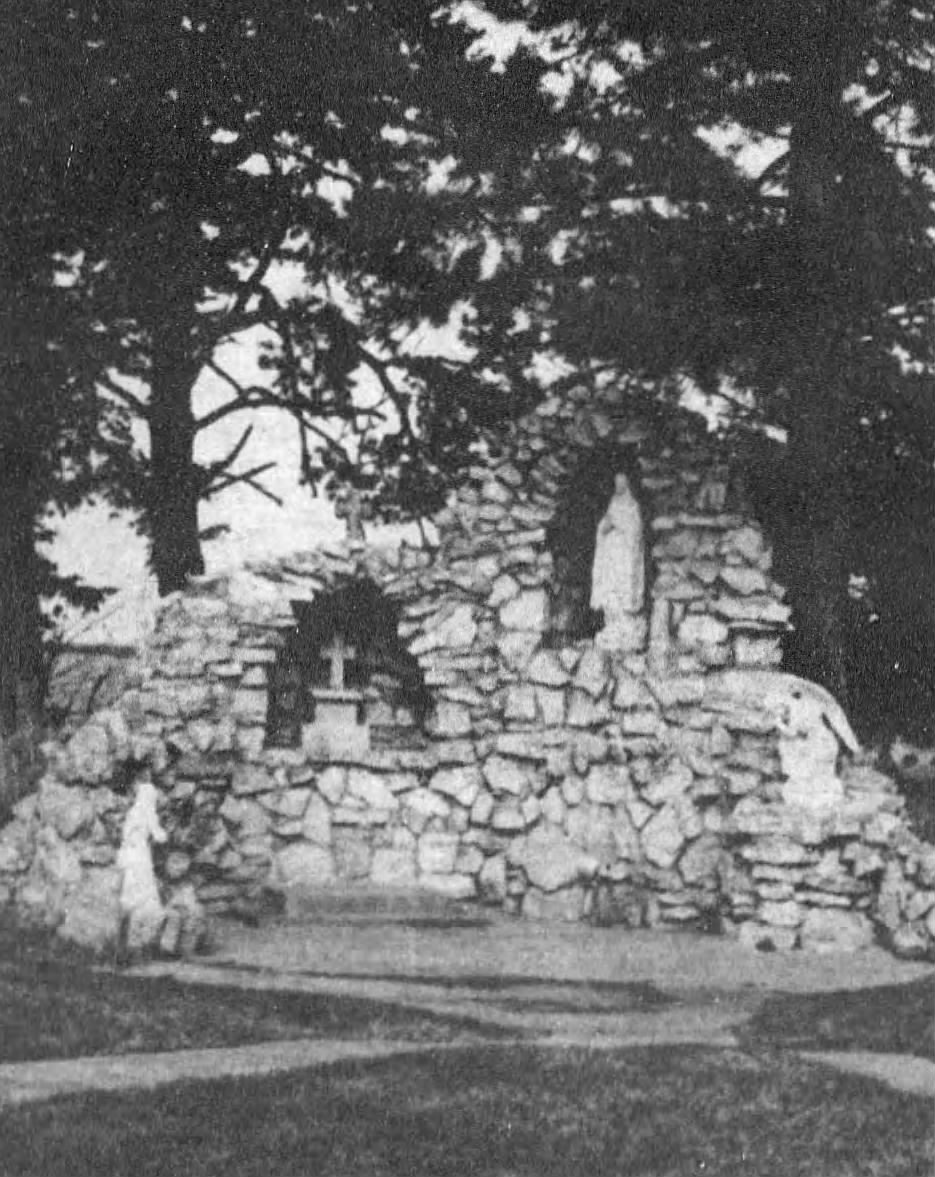
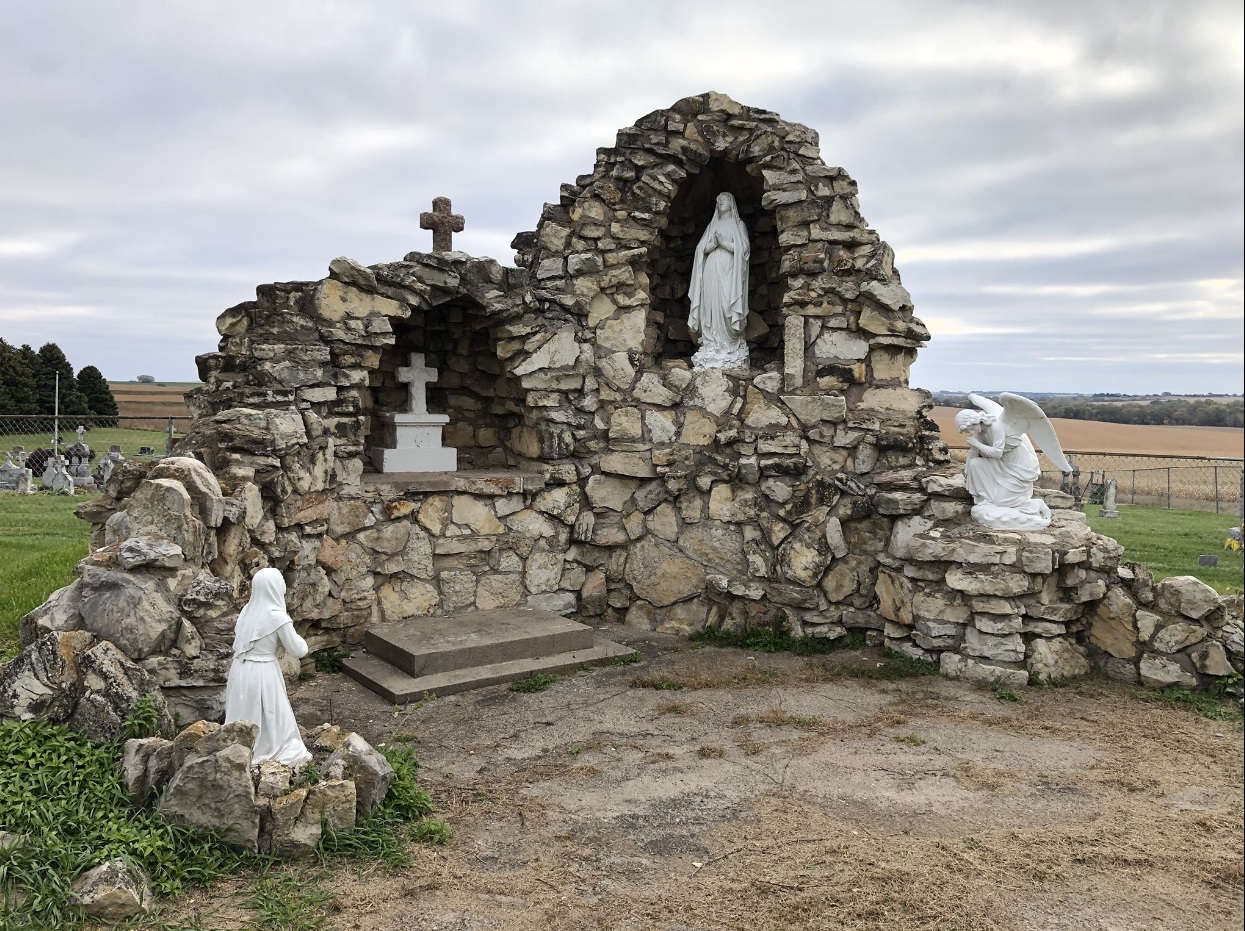
Sts. Cyril & St. Methodius Church, Plasi (Prague) (1936-1962, extant)
The Czech parish of Saints Cyril and Methodius was established in the tiny town of Plasi (Prague) in 1871, and a church was constructed 1877. It was destroyed by fire in 1934 and was rebuilt that same year. In 1936, an announcement appeared the Lincoln Diocese newspaper:
Work is expected to be started immediately after harvest on the construction of grotto of Our Lady of Lourdes, It is to be constructed from the rock of the foundation of the old church. The plans have been prepared by Mr. Nachtigall, an architect of Omaha. Southern Nebraska Register, Jul 12, 1936
And a few months later, an update was published:
Work has started on the construction of a grotto of Our Lady of Lourdes. The foundation is now laid, and further work will be continued this week by J. T. Pallat of Wahoo, who has made a hobby of artistic masonry. Southern Nebraska Register, Oct 4, 1936
But then, nothing. Not for another 24 years. In 1962, however, a long-overdue update was published:
Grotto Started in 1937 at Prague Is Finished By Robert Dorr For 24 years a beautiful stone grotto on a hilltop in the Bohemian Alps near here stood unfinished, The builder, Joseph L. Pallat, had started it in 1937, worked on it in his spare time, then left for California in about 1940. Nothing was done on the grotto for 19 years. “Joe’ll be back,” the Rev. John B. Pastorak kept telling the members of Sts. Cyril and Methodius Catholic Church, where the grotto is located.
Three years ago Mr. Pallax, who had been an attorney in Wahoo, Neb., came back on his vacation. “It wasn’t much of a vacation, though,” said Father Pastorak. “He saw the unfinished grotto and went to work.” Mr. Pallat worked through the heat of the day even though he was in his 60’s. The men of the church put the stones where he directed. Mr. Pallat returned each summer since to finish the work.
Sunday afternoon it will be blessed by Lincoln Bishop James V. Casey, who also will officiate at the first outdoor mass in the church’s history. The Rev. Thomas Allen, prior of St. John’s Seminary and Mount Michael Monastery at Elkhorn, will speak. Mr. Pallat won’t be there. He left a couple of weeks ago for his California home. “He’s so humble he was afraid some one would give him a tribute.” Father Pastorak said.
The site of the grotto and church is five miles southwest of here, where the town of Plasi was located. It died out about 75 years ago when it was bypassed by the railroad, and the only buildings there now are the parsonage and church. Omaha World-Herald, Jul 8, 1962
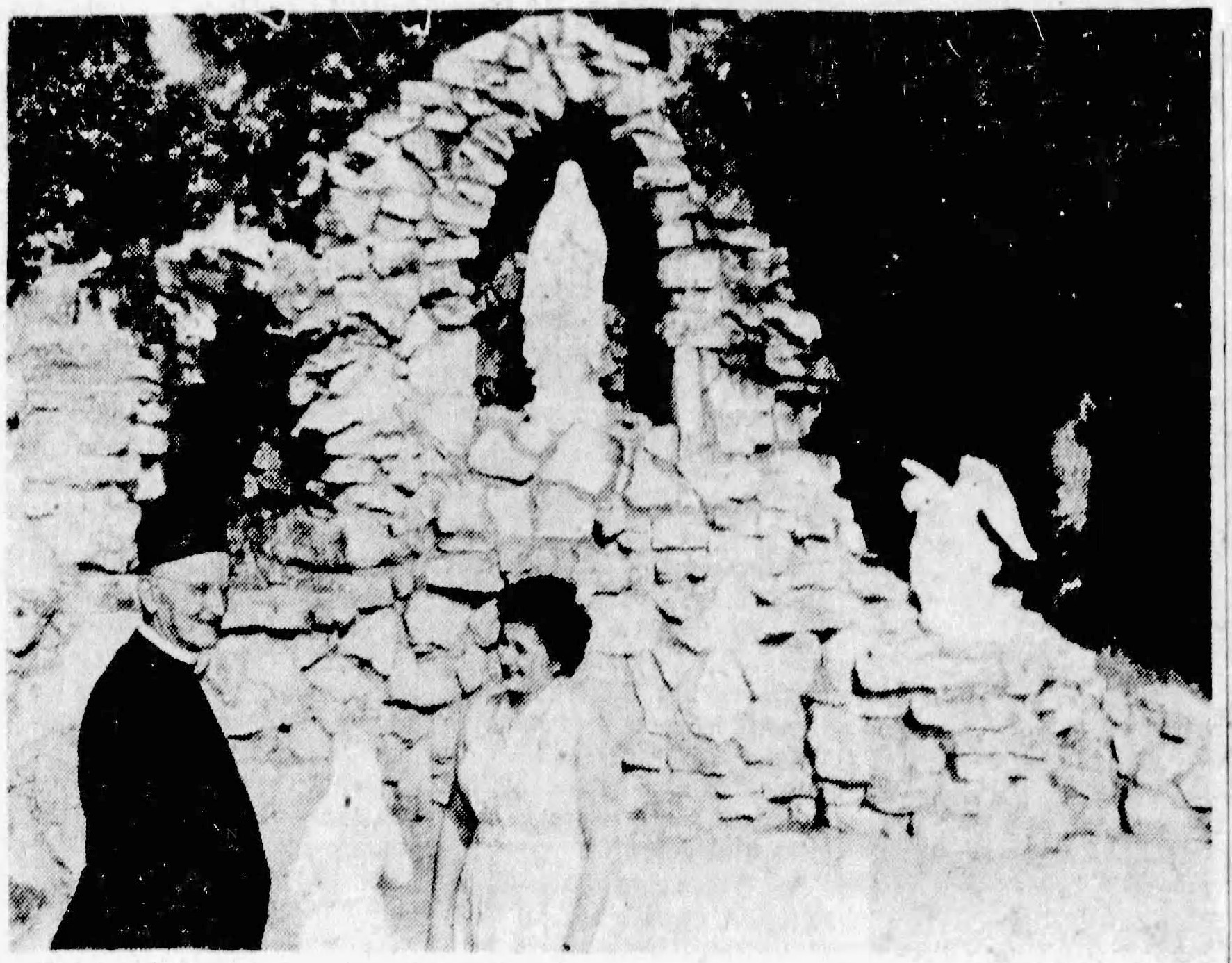
Sts. Cyril & St. Methodius Church in Plasi continues to be an active parish despite its rural setting, as a mission church from St. John’s in Prague, and the grotto endures yet to this day.
Our Lady of Lourdes Hospital, Norfolk (1940, not extant)
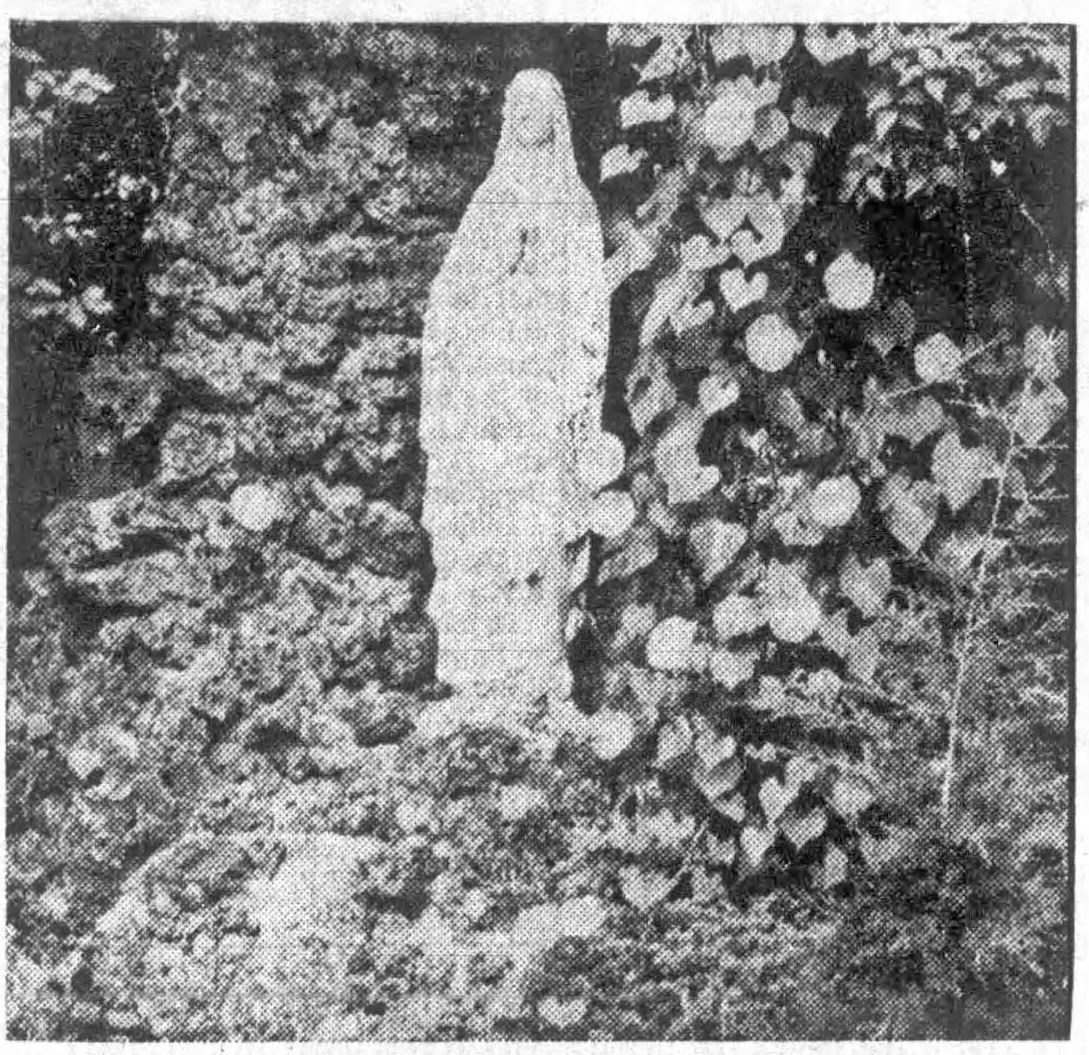
Our Lady of Lourdes Hospital was established in Norfolk, Nebraska in 1935 by the Benedictine Sisters, who then built Immaculata Monastery next door to the hospital. In 1940, the Sisters added a wing to the hospital and also built in a garden between the two facilities:
They also have just completed a between the hospital and convent, in which there is a statue of Virgin Mary. The sisters constructed the grotto of clinkers and stones, and made it attractive with vines, ferns and flowers. Norfolk Daily News, Sep 10, 1940
The hospital is now permanently closed, but the monastery is still active. It seems that the grotto has been removed, although the statue of Our Lady of Lourdes still stands on the grounds of the Monastery.
St. Mary’s Hospital, Nebraska City (1942, partially extant)
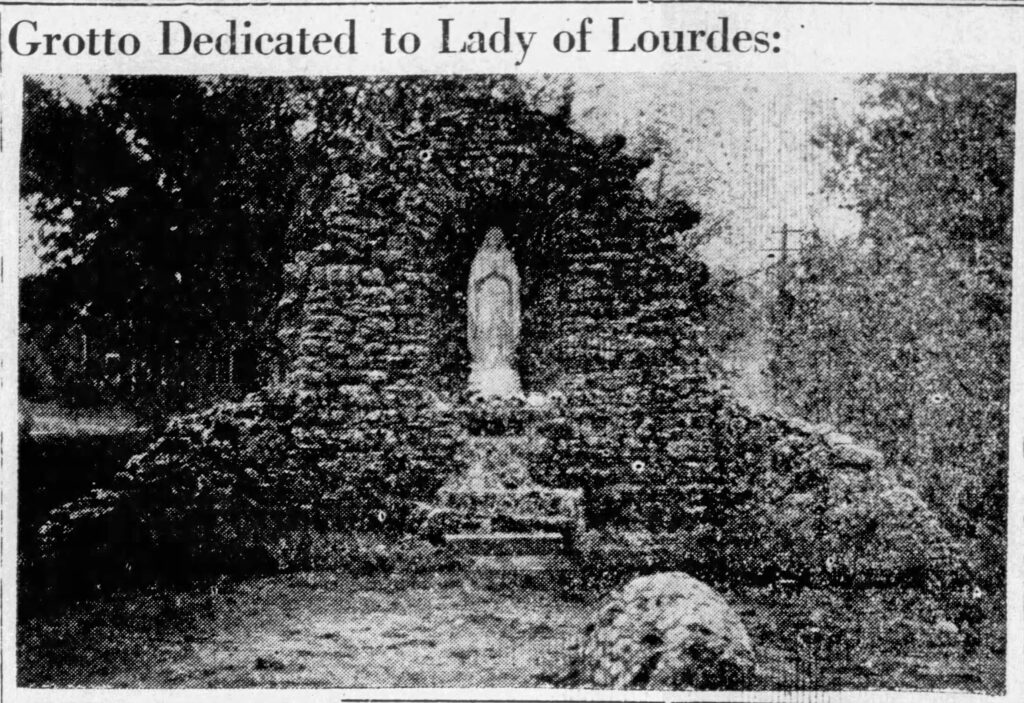
A 1942 newspaper article announced the completion of a grotto at St. Mary’s Hospital in Nebraska City:
St. Mary’s hospital last week completed construction of a massive grotto which soon will be dedicated to Our Lady of Lourdes… which stands on the hospital grounds at the northeast corner of the building. At the foot of a canopy, under which stands a white stone statue of the Virgin Mary, is a fountain symbolizing the healing waters of Lourdes….
Construction of the Nebraska City grotto was supervised by Frank P. McIntyre, a retired Hannibal, Mo., lumber and coal merchant. McIntyre states he had no plans or blueprints to follow, but placed rocks “where they would do the most good.” Andy Brust, Nebraska City, laid most of the rock. The base and canopy are of “rotten stone,” a swiss cheese-like rock contributed by Dr J. J. Reichman of Hannibal. It was quarried from a hillside where hundreds of tons remain. A plate to be set into the grotto notes Dr Reichman’s contribution. Set into the middle of the base is a pillar of crystal rock over which water from the fountain plays. When floodlighted at night or exposed to the sun, the rock sparkles. Bases of benches and the tiny floodflight house are built of the same “rotten stone.” Grounds surrounding the grotto are landscaped with blue spruce and ornamental evergreens.
The statue was sculptured by the Daprato Studio in Chicago. It is five feet high and weighs over 600 pounds. Main section of the grotto is 12 feet wide and 13 1-2 feet high. A six foot semi-circular wing extends around the sides and back. McIntyre estimates the entire structure to weigh more than 100 tons.
The grotto is the second McIntyre, who with his wife lived at the hospital during construction, has built. His first was at Hannibal, where the Sisters of St. Francis who operate St. Mary’s also have a hospital. “I believe this is better than the first,” he said last week. McIntyre got his ideas for the grotto by visiting similar shrines in this section, then called upon long experience in the building business for construction details. It is believed here, the Nebraska City grotto is the only one of its kind in southeast Nebraska. Nebraska Daily News-Press, Sep 20, 1942
A few weeks later it was reported that: “The new grotto at St. Mary’s hospital was dedicated Sunday impressive ceremonies conducted by Most Rev Bishop Louis B. Kucera, D. D., of Lincoln before a crowd of several hundred on the hospital grounds.” (Nebraska Daily News-Press, Oct 12, 1942)
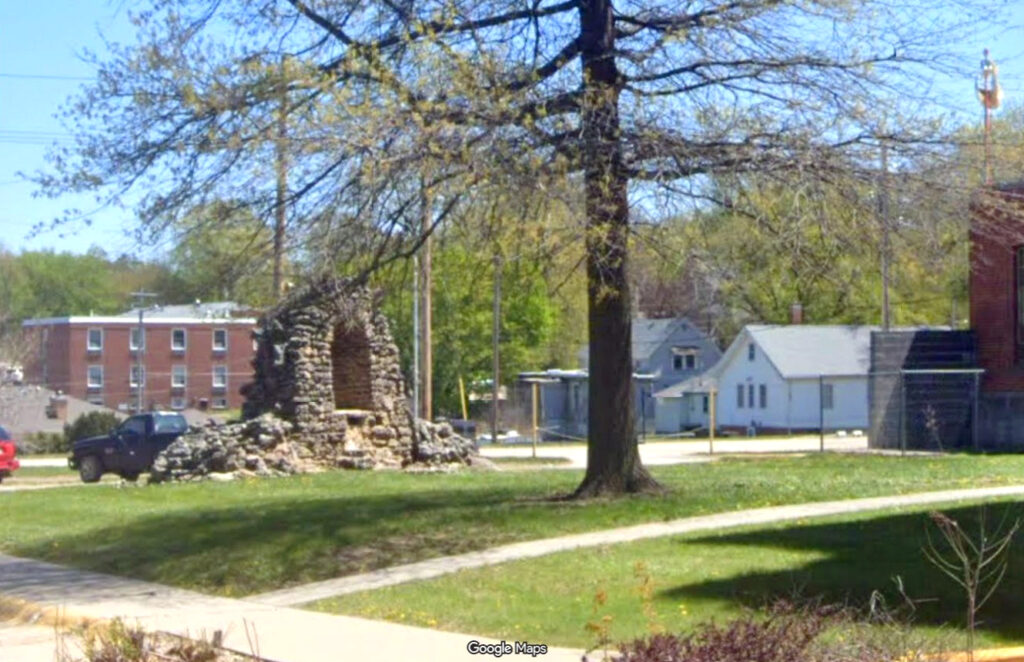
The original St. Mary’s Hospital building was closed in 2014 when a new building was opened. The grotto appears to still stand–minus its statue of Our Lady–on the northeast corner of the block, at 1314 3rd Avenue. The hospital building was been listed for sale in 2017 but is no longer an active listing.
St. Bernard’s Academy / Lourdes Central Catholic School, Nebraska City (1944, extant)
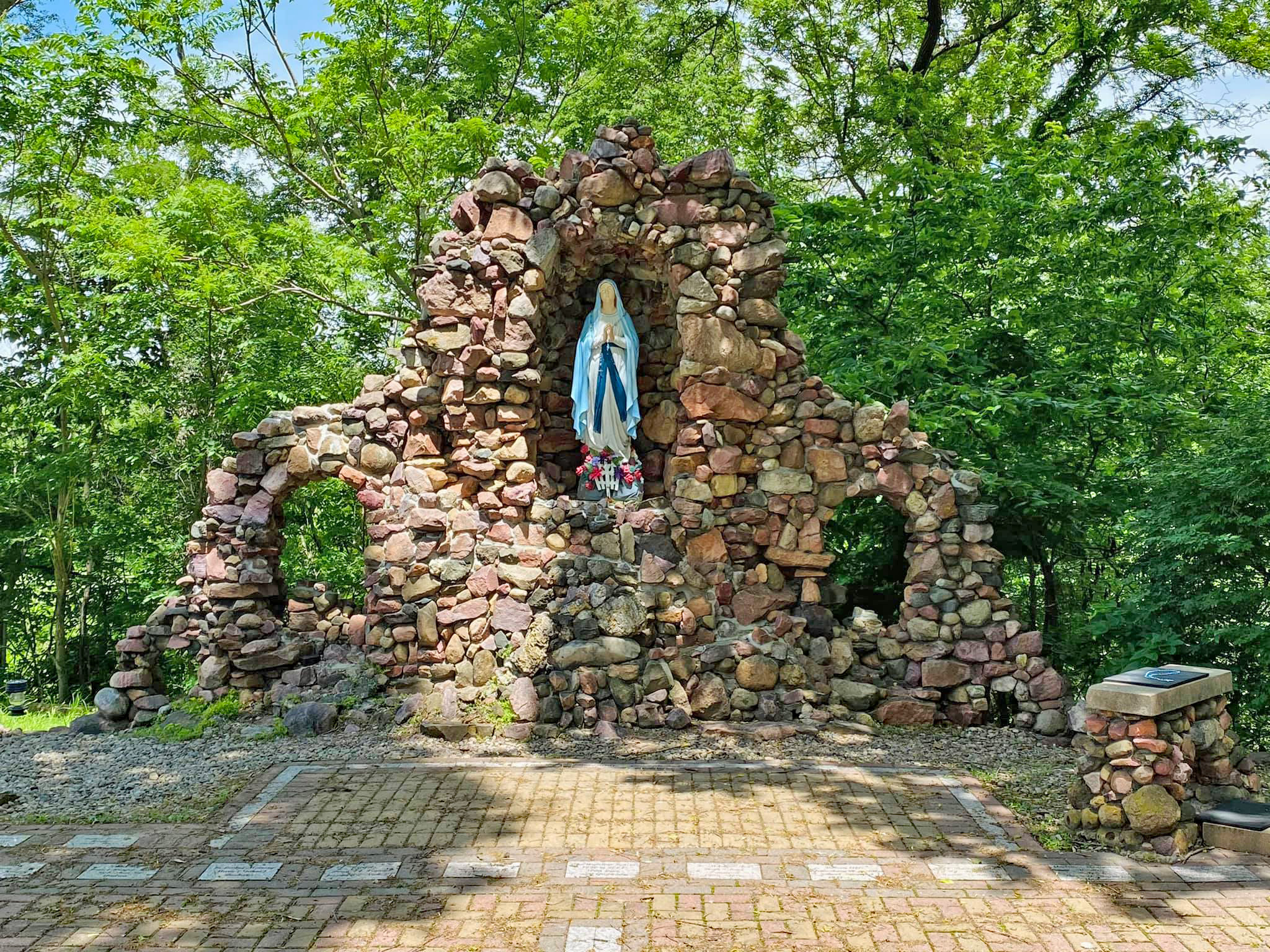
Less than a mile east of the former St. Mary’s Hospital building in Nebraska City is Lourdes Central Catholic School (at the location of the former St. Bernard’s Academy). In 1944 (only two years after the completion of the hospital grotto), this was announced:
School Grotto Is Nearing Completion Building of an attractive grotto on the grounds of St. Bernard’s school, facing Second Avenue and northeast of the main building, is practically complete as to the stonework and the placing of two statues, one of the Blessed Virgin and the other of Bernadette, will be done soon.
The grotto itself is constructed of field stones, similar to those used in the main building, taken from the Lowrey farm northwest of Nebraska City. Merritt James managed the construction. Completed, the grotto will be flood-lighted, as is the installation of St. Mary Hospital grounds. Nebraska City News Press, Aug 11, 1944
I could not find any announcement of a dedication or blessing of the grotto, or early newspaper photos of it, only several announcements during the 1950s of crowning ceremonies for the statue of Our Lady held there.
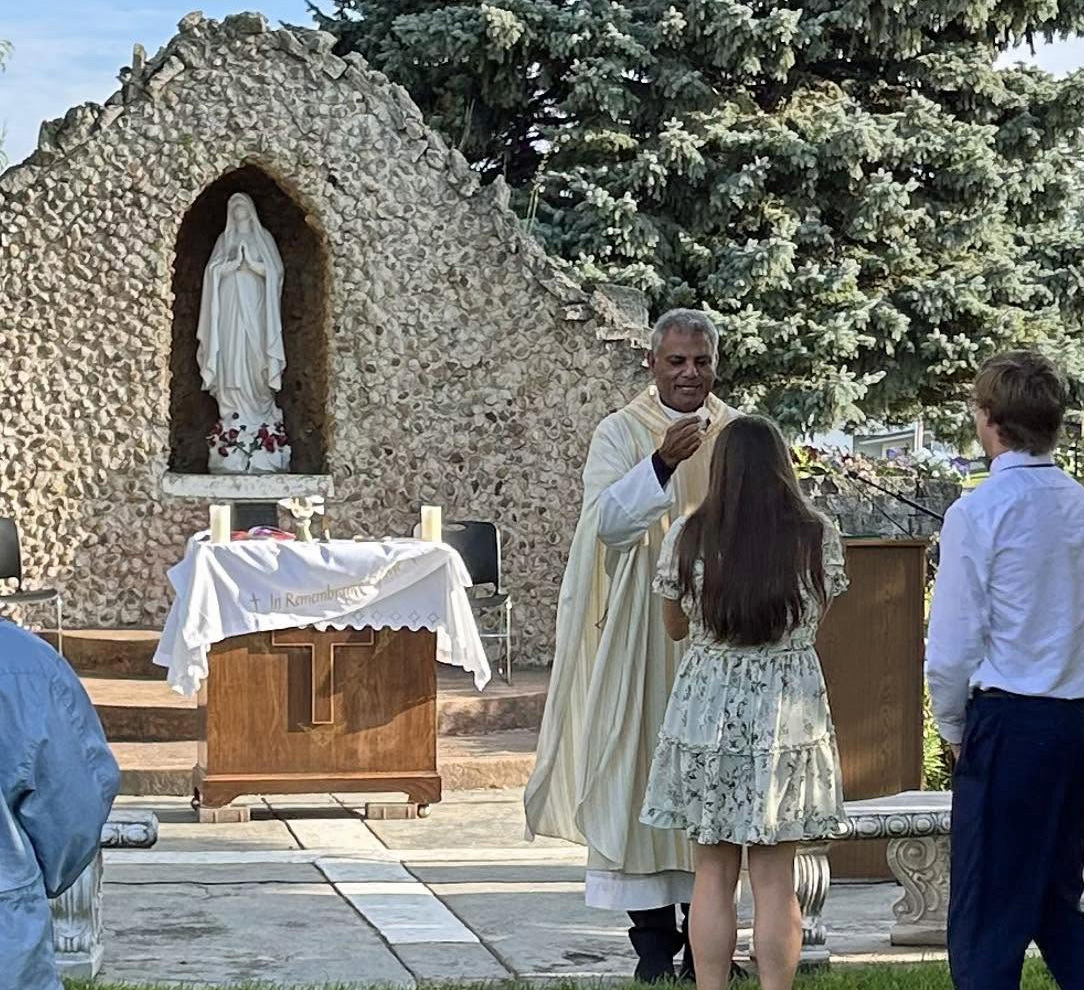
In June 2021, the school’s Facebook page announced that the grotto had been restored by McGill Restoration. Today, the grotto at Lourdes Central Catholic School remains a beautiful and peaceful spot for prayer and open-air masses.
Holy Trinity Convent and Church, Hartington (before 1943, extant)
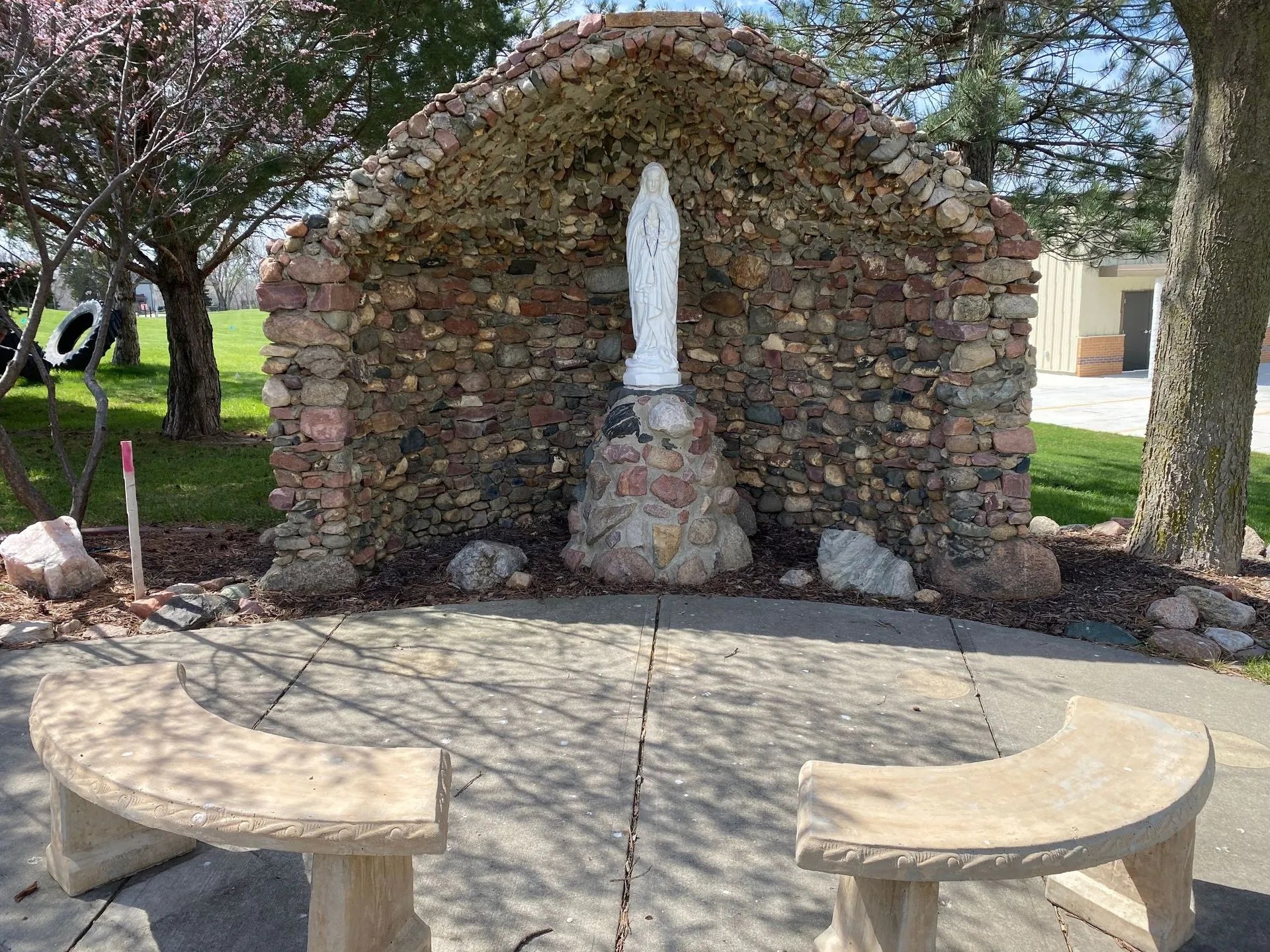
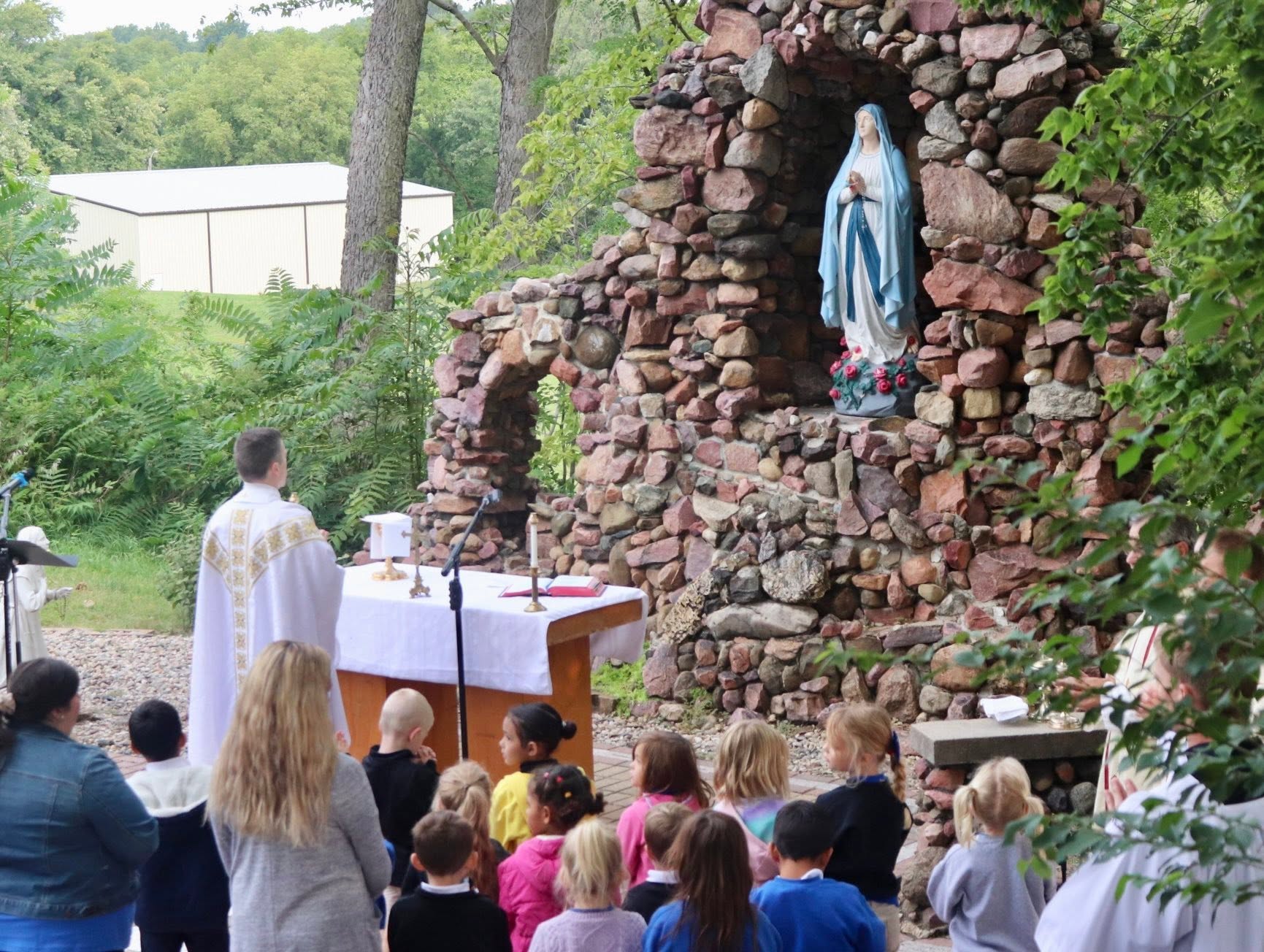
The website for Holy Trinity Church has a detailed history of the church and schools in Hartington, including some information about the grotto on the grounds of the school and convent there, established in 1901 by the Ursuline Nuns, who oversaw the school until 1943.
The grotto was built between those years; the church history states that the school was taken over in 1943 by the Benedictine Sisters, and that “Upon arrival, the Benedictine Sisters were impressed with the spacious grounds, the stately pine trees, the grotto of our Lady and the lily pond.”
The church website states that “There were no records of the original designer and builder of the grotto,” and apparently no early photos of it have been located.
However, I was able to find a 1935 article:
A spiritual retreat, beginning today and continuing until Friday next week, is being conducted at the Mount St. Joseph Ursuline convent at Hartington by members of the Cappuchin order of priests from Lincoln. A new grotto at the convent, donated by friends Sister M. Gabriel, a member the Ursuline order here, is being erected. No visitors will be admitted at convent during the period of the retreat. Cedar County News, Jun 19, 1935
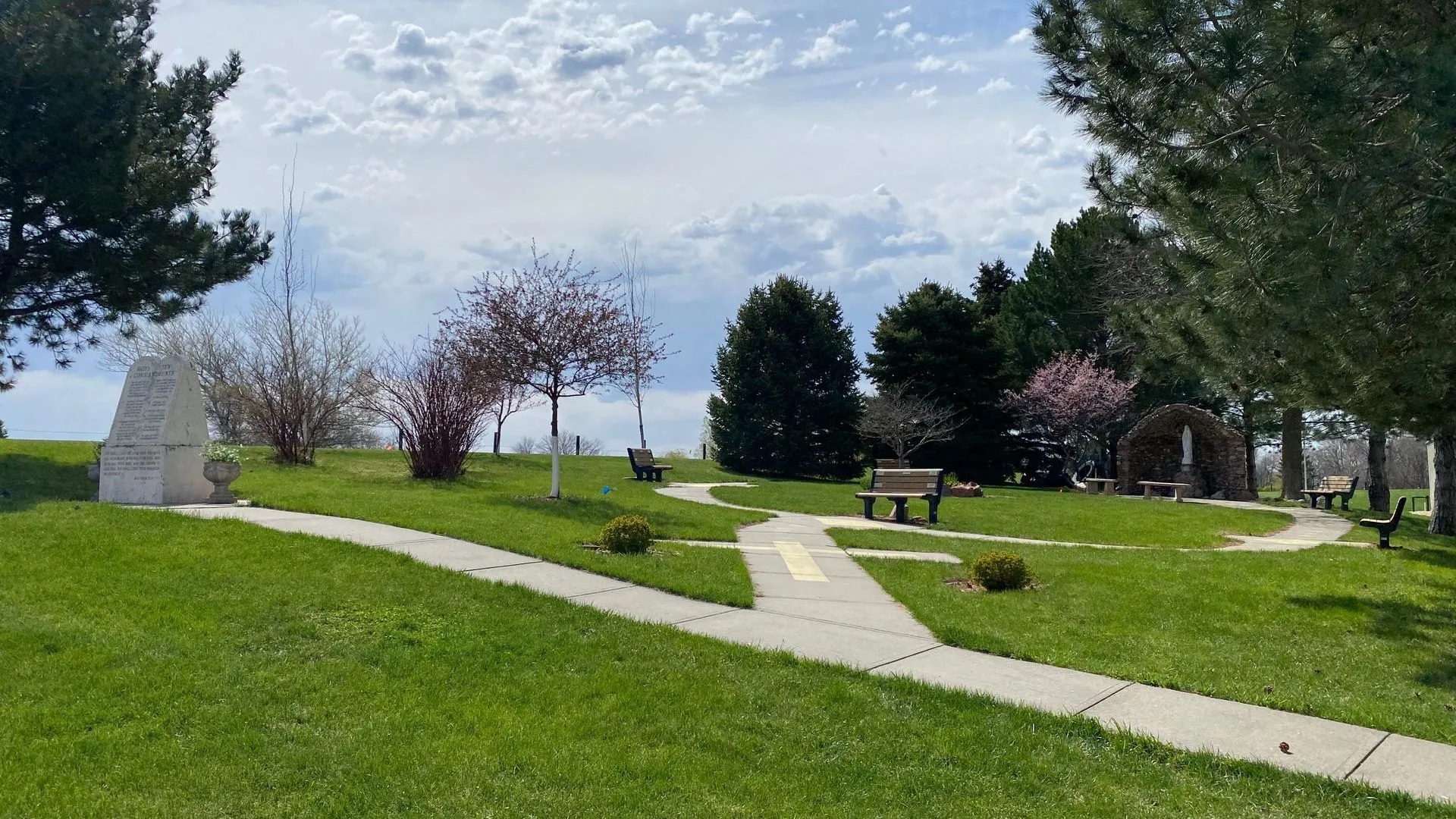
The Benedictine Sisters remained in Hartington until the 1980s. After they left, the convent stood unused until it was destroyed in 1988. The grotto became derelict, until it was restored by the Knights of Columbus in 2006-2007. They reinstalled the statue, and added benches and landscaping. The grotto is now beautiful and visited by the faithful again, thanks to their efforts.
St. Joseph’s Hospital, Alliance (before 1948, not extant)
I could not find any reference to this grotto except this 1948 newspaper photo and caption:
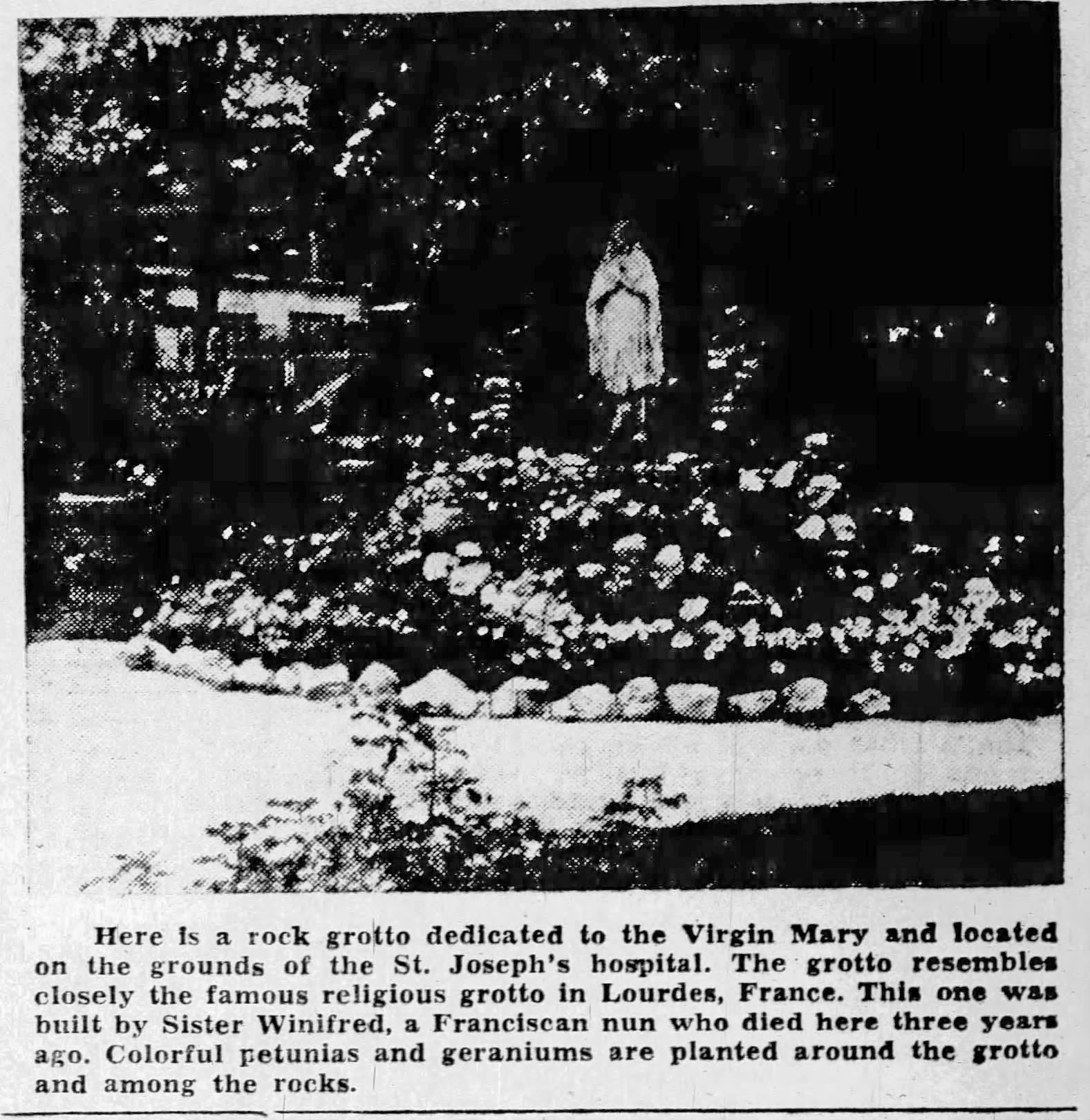
St. Joseph’s Hospital no longer exists in Alliance. The hospital’s former site is now St. Agnes Park, across the street from St. Agnes Catholic Academy and two blocks from Holy Rosary Church. The park includes a grotto of St. Joseph, but it is clearly a different grotto, and at the southeast corner of the school stands another grotto with a statue of St. Agnes. The original hospital grotto has not survived, and the statue of Our Lady could not be seen outside either the school or the church.
St. Patrick’s Church, Sidney (1954, not extant)
I found a 1954 diocese newspaper article about the dedication of a new Lourdes grotto at St. Patrick’s Church in Sidney:
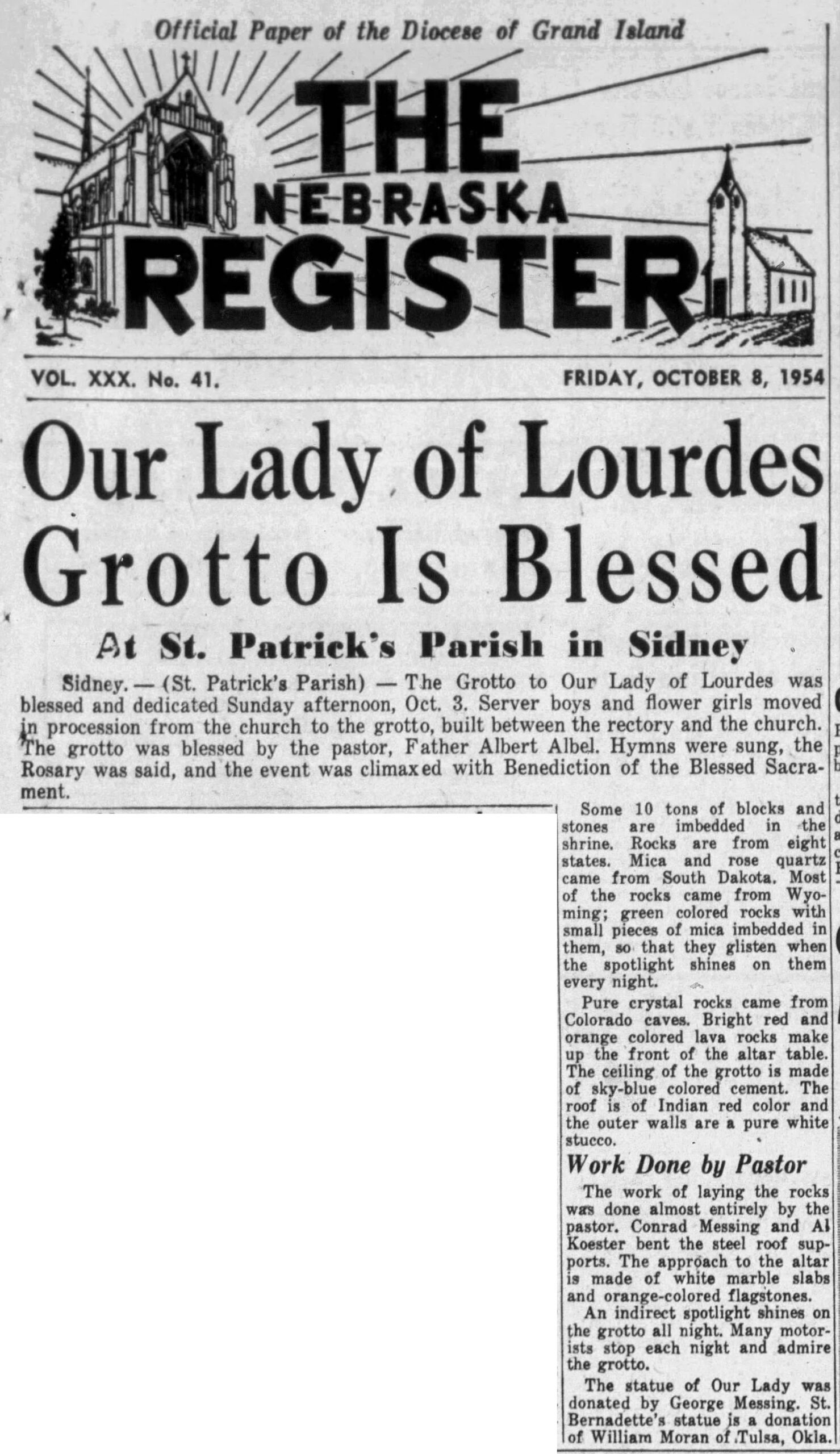
The Grotto to Our Lady of Lourdes was blessed and dedicated Sunday afternoon, Oct. 3. Server boys and flower girls moved in procession from the church to the grotto, built between the rectory and the church. The grotto was blessed by the pastor, Father Albert Albel. Hymns were sung, the Rosary was said, and the event was climaxed with Benediction of the Blessed Sacrament.
Some 10 tons of blocks and stones are imbedded in the shrine. Rocks are from eight states. Mica and rose quartz came from South Dakota. Most of the rocks came from Wyoming; green colored rocks with small pieces of mica imbedded in them, so that they glisten when the spotlight shines on them every night. Pure crystal rocks came from Colorado caves. Bright red and orange colored lava rocks make up the front of the altar table. The ceiling of the grotto is made of sky-blue colored cement. The roof is of Indian red color and the outer walls are a pure white stucco.
Work Done by Pastor: The done work almost of laying the rocks was entirely by the pastor. Conrad Messing and Al Koester bent the steel roof supports. The approach to the altar is made of marble slabs and orange colored flagstones. An indirect spotlight shines on the grotto all night. Many motorists stop each night and admire the grotto. The statue of Our Lady was donated by George Messing. St. Bernadette’s statue is a donation of William Moran of Tulsa, Okla. The West Nebraska Register, Oct 8, 1954
The grotto no longer exists next to St. Patrick’s Church, a beautiful church which has been extensively remodeled, and next to which stands a parish hall dedicated in 1995 and a parking lot.
Church of the Holy Spirit, Plattsmouth (1985, extant)
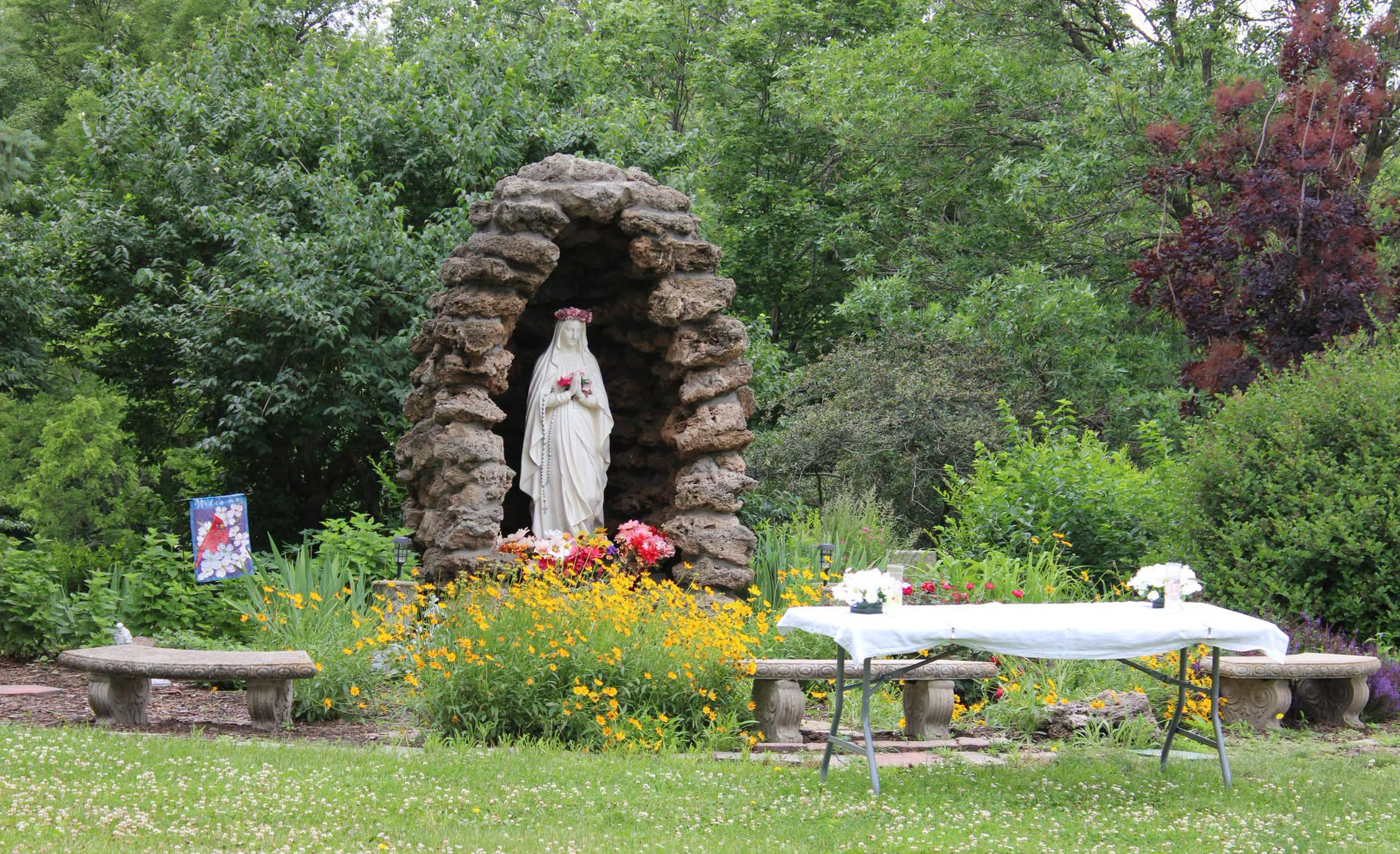
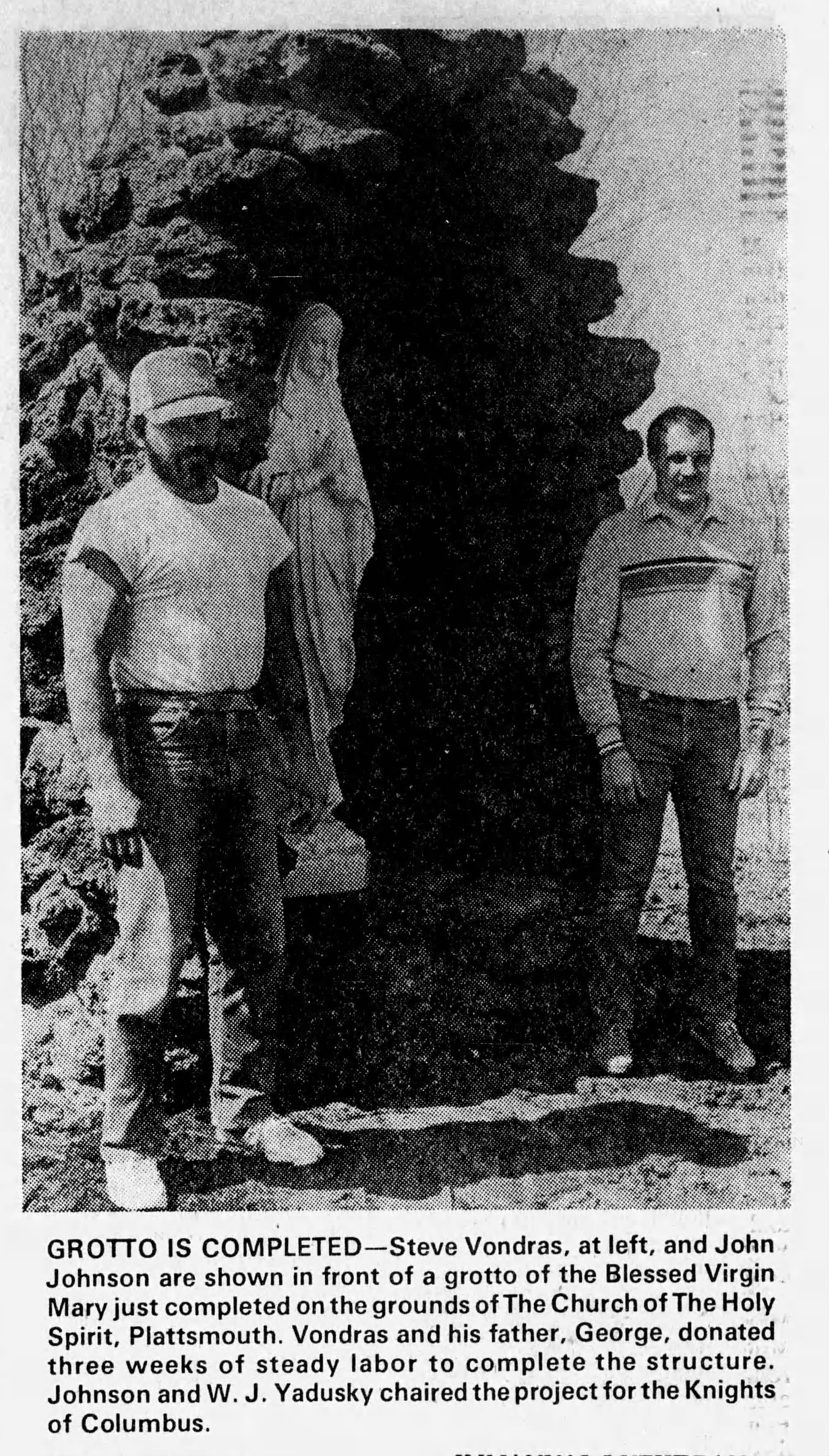
An April 1985 article announced:
Steve Vondras… and John Johnson… in front of a grotto of the Blessed Virgin Mary just completed on the grounds of The Church of The Holy Spirit, Plattsmouth. Vondras and his father, George, donated three weeks of steady labor to complete the structure. Johnson and W. J. Yadusky chaired the project for the Knights of Columbus. The Plattsmouth Journal, Apr 11, 1985
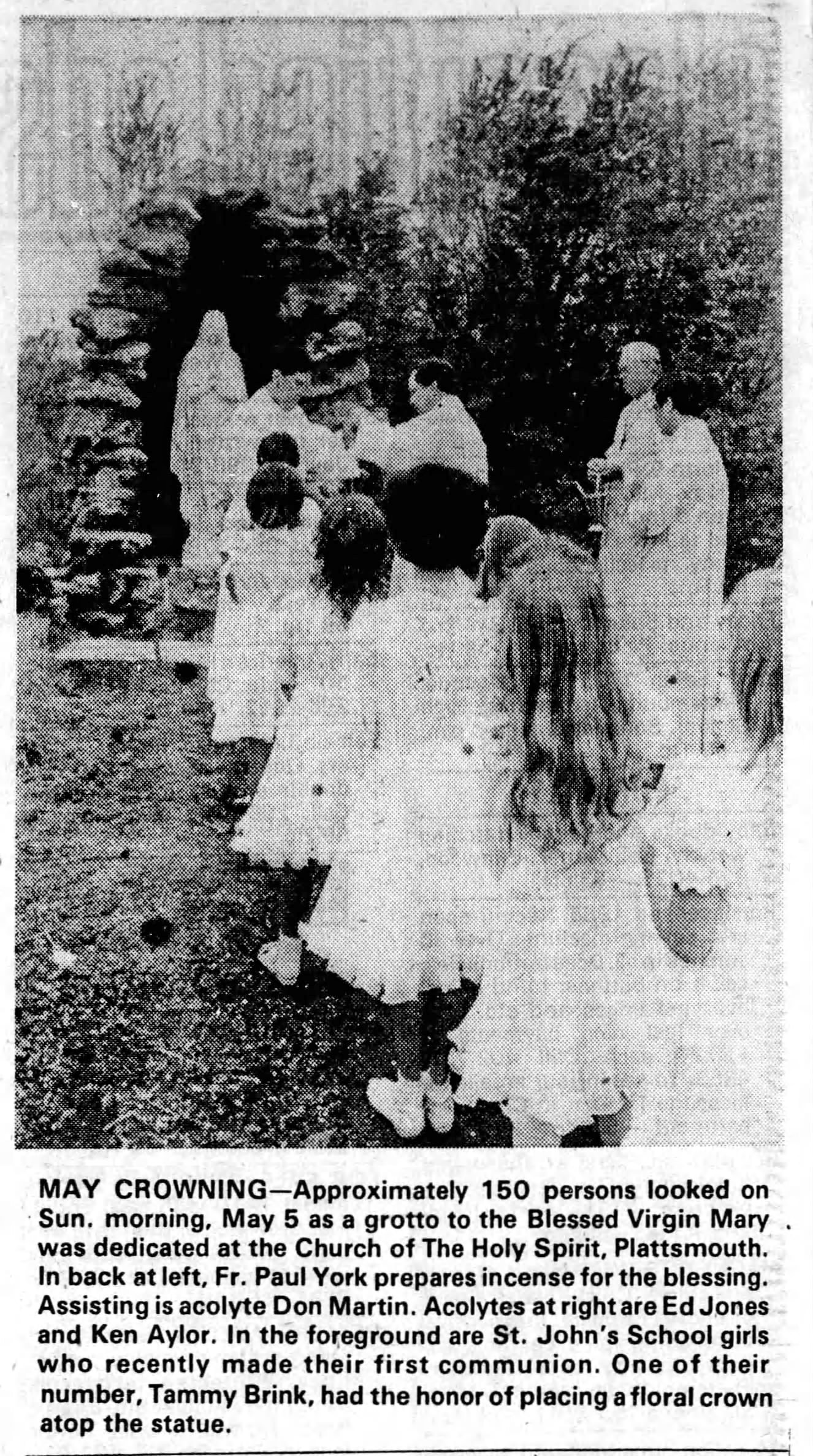
And another article the following month had a photo of a May crowning and the blessing of the grotto by Father Paul York:
Approximately 150 persons looked on Sun. morning, May 5 as a grotto to the Blessed Virgin Mary was dedicated at the Church of The Holy Spirit, Plattsmouth. The Plattsmouth Journal, May 9, 1985